



Managing Cumulative Mechanical Failure with Continuous Solvent Recovery Systems
The transition from successful benchtop chemistry to industrial scale manufacturing is often misunderstood as a simple exercise in repetition. Many researchers operate under the assumption that once a chemical reaction is optimized at a small scale, the primary challenge is complete. However, scaling an organic process is not merely a chemical milestone but a profound engineering transition. In the laboratory, a single failure is an inconvenience; at scale, failure is cumulative and quiet. It manifests as a degrading seal, a vacuum pump losing efficiency, or a recurring maintenance rebuild that slowly erodes total throughput. To navigate this shift successfully, facilities must move away from the batch centric mental model and embrace robust infrastructure like continuous solvent recovery systems to manage the mechanical stresses of high volume production.
The Fallacy of Repetition in Chemical Scale Up
The belief that industrial production is just laboratory work performed at a larger volume is a significant hurdle for emerging chemical enterprises. At the benchtop, the mechanical integrity of equipment is rarely the limiting factor because the run times are short and the physical stresses are minimal. When a process is moved to 50 liters or higher, the physics of the environment changes fundamentally. Heat transfer becomes non linear, and the mechanical components of the reactor are subjected to constant chemical and thermal fatigue.
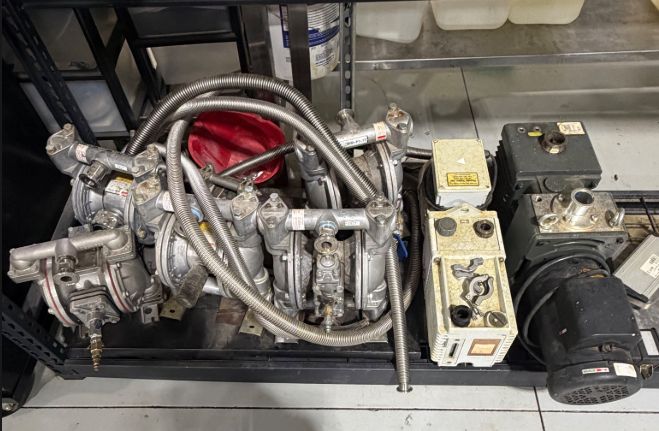
Scale up failure is rarely a dramatic event; instead, it is a process of attrition. A pump that worked for months in a research setting may fail every two weeks when integrated into a continuous workflow. This cumulative mechanical failure defines the reality of industrial throughput. By utilizing continuous solvent recovery systems, engineers can mitigate these issues by creating a steady state environment that avoids the high stress cycles of heating and cooling inherent in traditional batch systems.
Identifying Mechanical Vulnerabilities in High Volume Systems
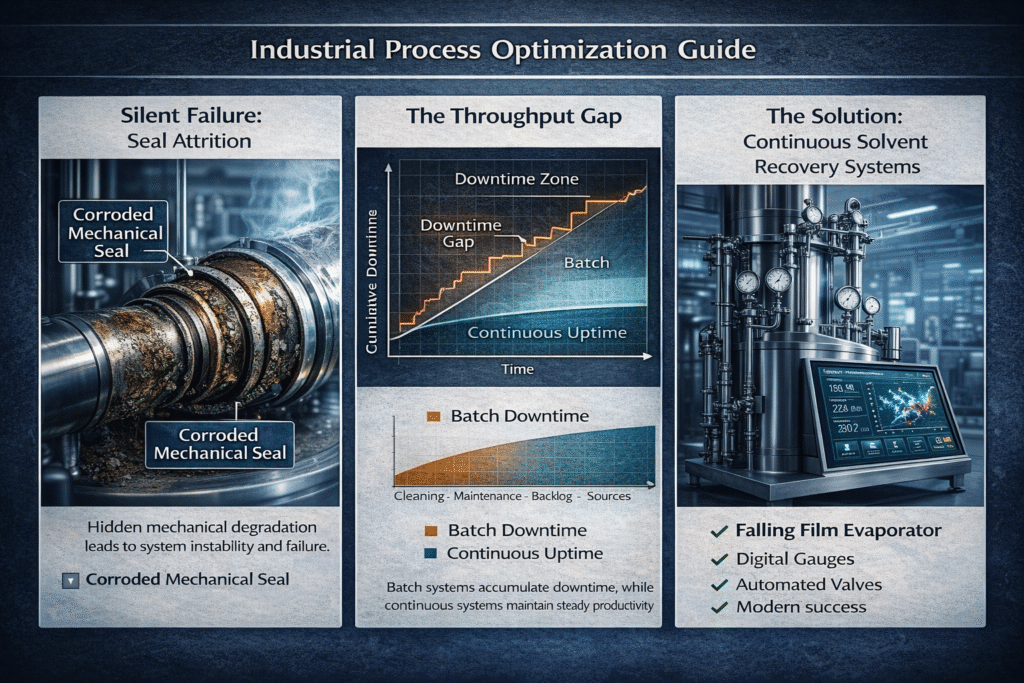
To achieve consistent throughput, a team must identify where the quiet failures are most likely to occur. Seals and gaskets are the primary culprits, as they often undergo microscopic deformation or creep under the prolonged vacuum and temperature requirements of a large scale reaction. In many cases, these seals begin to fail during critical production runs, leading to lost batches and expensive downtime.
Furthermore, the reliance on fragile laboratory grade glassware for large volumes introduces a significant risk of thermal shock. This is why the industry is shifting toward stainless steel continuous solvent recovery systems. These systems are engineered to withstand the rigorous demands of 24/7 production, featuring reinforced mechanical joints and high duty cycle pumps that are designed for industrial longevity rather than temporary experimentation. Understanding that every component has a finite lifespan is the first step in building a resilient manufacturing operation.
Strategic Benefits of Continuous Solvent Recovery Systems
The most effective way to manage the risk of cumulative mechanical failure is to simplify the operational workflow. Continuous solvent recovery systems offer a streamlined path by automating the removal and reclamation of solvents in real time. This automation reduces the human to hardware interaction, which is a common source of mechanical error in batch processing. When a system is designed for continuous flow, the mechanical components are balanced for a specific load, reducing the erratic surges in pressure that can cause pump failure.
Moreover, continuous solvent recovery systems integrate high fidelity monitoring tools that can predict failure before it occurs. By analyzing the metabolic landscape and structural stability of the compounds being processed, researchers can ensure that the mechanical parameters of the recovery system do not exceed the stability limits of the molecule. This synergy between chemical stability modeling and industrial engineering ensures that the product maintains its binding affinity and purity, even as the hardware manages thousands of liters of throughput.
Conclusion
Success at scale requires a fundamental shift in perspective where throughput is viewed as an engineering problem that must be solved with precision hardware. The quiet failure of seals and pumps is a signal that the infrastructure has been outpaced by the chemistry. By adopting continuous solvent recovery systems, facilities can move beyond the trust based batch model and toward a data driven, automated production cycle. This transition ensures that the cumulative mechanical stresses of scaling are managed proactively, allowing the chemistry to reach its full commercial potential without being sidelined by predictable hardware fatigue