


The Multi-Disciplinary Frontier of Cannabinoid Science
The rapidly evolving landscape of cannabinoid science requires a convergence of diverse scientific disciplines to unlock the full therapeutic potential of these complex molecules. As the industry moves toward pharmaceutical rigor, research must move beyond simple extraction and into the realms of advanced computational chemistry, innovative synthesis, and stringent safety validation. By integrating theoretical modeling with practical laboratory execution, scientists are now able to predict molecular behavior, optimize production through green chemistry, and establish robust safety profiles that meet global regulatory standards. This comprehensive approach is essential for transforming raw botanical data into validated medical breakthroughs.
Computational In Silico Exploration and Molecular Docking
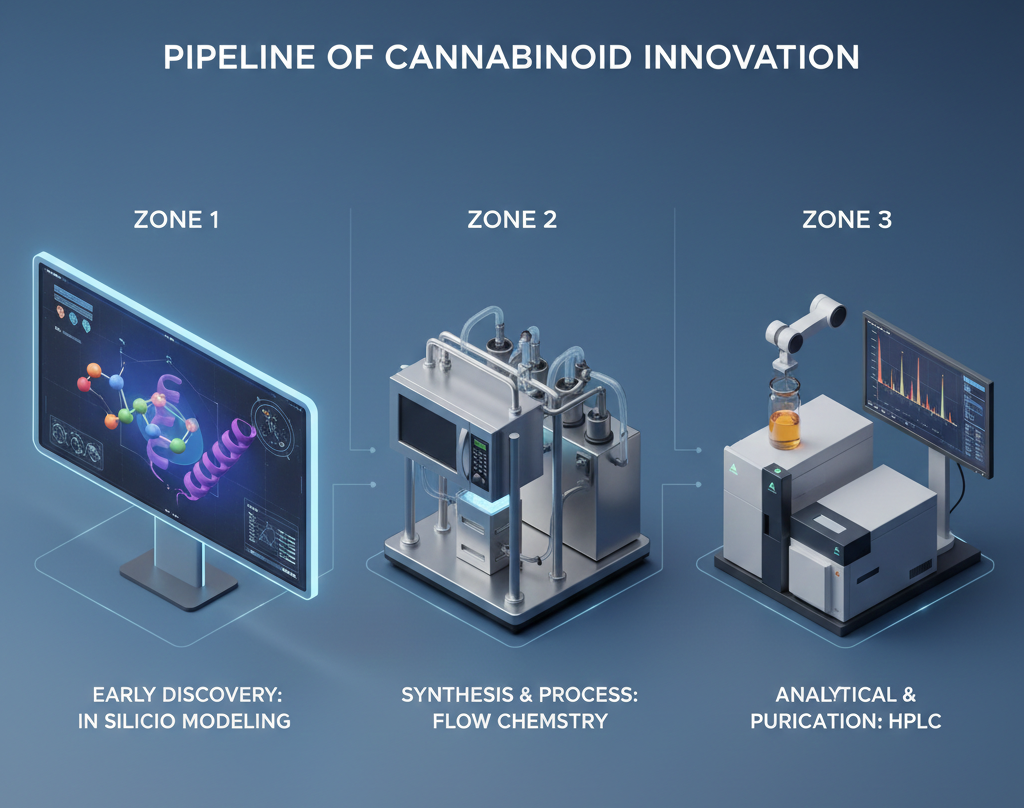
A significant portion of modern drug discovery occurs within digital environments before a single vial is filled in the laboratory. In silico exploration involves using high performance computing to simulate the interactions between cannabinoids—specifically those produced via combustion or vaporization—and human protein targets. These studies utilize molecular docking to predict the binding affinity of various ligands to cannabinoid receptors and other metabolic enzymes.
By modeling these interactions, researchers can identify which chemical structures are most likely to produce a desired therapeutic effect while minimizing off-target activity. This predictive capability is particularly useful for studying the “minor” cannabinoids and their derivatives, providing a roadmap for future clinical investigations. Understanding how these compounds dock at a molecular level allows for the rational design of new therapies that are tailored for specific physiological pathways.
Advanced Synthesis and Microwave Modified Continuous Flow Chemistry
The field of synthetic chemistry is undergoing a transformation through the adoption of continuous flow systems, often enhanced by microwave and ultrasonic energy. Unlike traditional batch processing, continuous flow chemistry allows for precise control over reaction parameters such as temperature, pressure, and residence time. This leads to higher yields, improved safety, and significantly reduced waste, aligning with the principles of green chemistry.
In the cannabinoid space, these technologies are used to synthesize rare diastereomers and novel analogs with high purity. Characterizing these diastereomers is crucial, as the three dimensional orientation of a molecule determines its biological activity. By leveraging microwave modification, chemists can accelerate reaction rates and access chemical spaces that were previously difficult to reach, driving innovation in the development of next generation cannabinoid based medicines.
Analytical Precision and Comprehensive Safety Validation
The foundation of any credible scientific study is the ability to accurately measure and verify results. High Performance Liquid Chromatography (HPLC) remains the gold standard for the precise separation and quantification of cannabinoids. Recent advancements in HPLC method development have allowed for the resolution of increasingly complex mixtures, ensuring that even trace amounts of impurities or minor compounds are identified. This analytical expertise is fundamental for maintaining consistency in research and ensuring that final formulations meet strict potency requirements.
Furthermore, a comprehensive safety assessment is non negotiable for consumer protection. Modern research entails evaluating the cytotoxicity and genotoxicity of cannabinoids to ensure they do not adversely affect human cells or genetic integrity. Specialized assays, such as the AMES test for mutagenicity and hERG ion channel screening for cardiac safety, are employed to identify potential risks early in the development cycle. By conducting these rigorous biological evaluations, the industry can provide the transparency and data needed for regulatory compliance and long term public safety.
Conclusion
Advancing the science of cannabinoids requires a relentless commitment to interdisciplinary excellence. From the initial computational predictions to the final stages of biological validation and safety screening, every step must be grounded in high level methodology. The integration of flow chemistry, analytical precision, and comprehensive safety profiles ensures that cannabinoid research remains at the cutting edge of modern medicine. As we continue to push the boundaries of what is possible, these combined expertise will remain the primary drivers of innovation, safety, and therapeutic discovery in the fascinating world of cannabinoid chemistry.