
From Field to Formulation: Leveraging Planar Chromatography for Rapid Molecular Screening
As the cannabinoid industry transitions into a highly regulated pharmaceutical and nutraceutical sector, the necessity for accessible and rapid analytical tools has become paramount. Thin Layer Chromatography (TLC) remains one of the most reliable and cost effective methods for the preliminary identification and separation of complex chemical mixtures. By utilizing a stationary phase and a mobile phase to migrate molecules across a flat surface, TLC allows researchers to visualize the chemical diversity of a sample in real time. This technique serves as an essential gateway in the laboratory, providing immediate insights into product purity and reaction progress before moving to more resource intensive instrumentation.
Principles of Differential Migration and the Stationary Phase
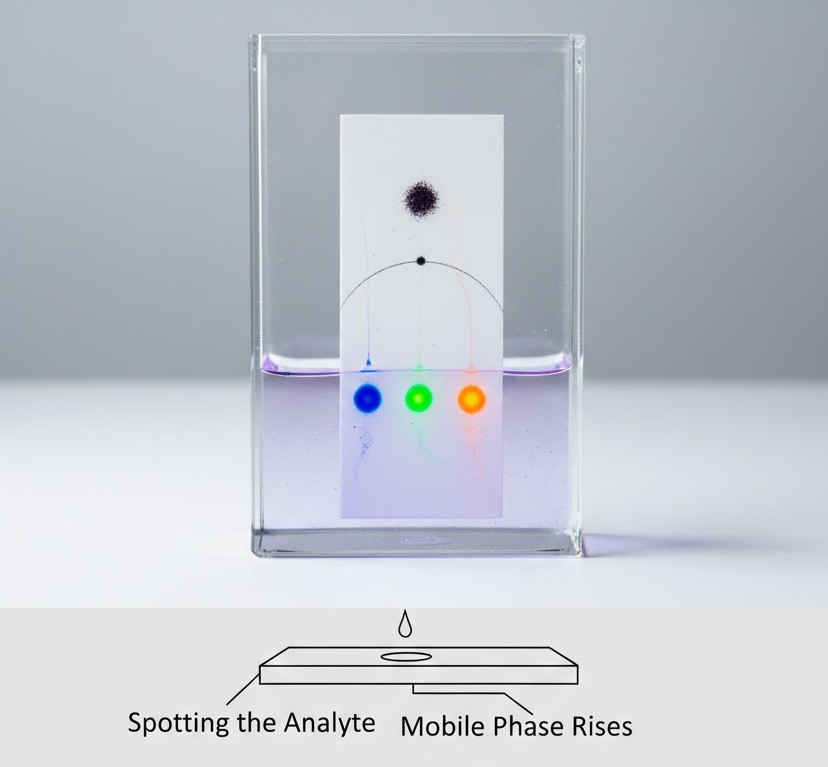
The fundamental mechanism of TLC relies on the interaction between the analyte and the stationary phase, which is typically a thin layer of silica gel or alumina coated onto a glass, plastic, or aluminum support. When a cannabinoid sample is “spotted” near the base of the plate and placed in a development chamber, capillary action draws the mobile phase (the solvent) upward. Molecules within the sample are carried by this solvent, but their speed is dictated by their individual polarity and affinity for the adsorbent material.
Cannabinoids with higher polarity will interact more strongly with the stationary phase, resulting in slower migration, while less polar compounds will move further up the plate. This differential migration is quantified by the Retention Factor (Rf), which is the ratio of the distance traveled by the compound to the distance traveled by the solvent front. For the laboratory scientist, the Rf value is a critical diagnostic tool, as it remains constant for a specific molecule under standardized conditions, allowing for the rapid identification of compounds like CBD, THC, or CBN based on established reference benchmarks.
Visualization Techniques and Qualitative Characterization
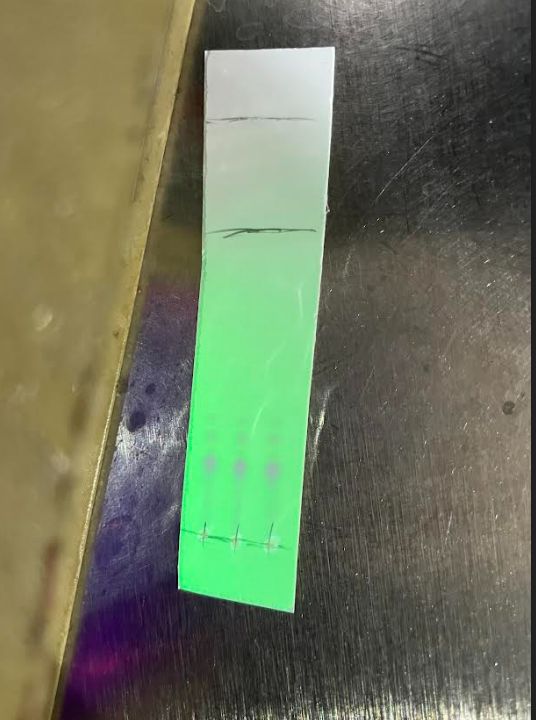
Because most cannabinoids are colorless to the naked eye, specialized visualization techniques are required to interpret the results of a TLC run. The most common method involves the use of Ultraviolet (UV) light at 254 nm, where compounds containing aromatic rings or conjugated double bonds appear as dark spots against a fluorescent background. For a more detailed chemical profile, researchers often employ “staining” or derivatization reagents, such as Fast Blue B or vanillin-sulfuric acid, which react with specific cannabinoid structures to produce characteristic color changes.
These visualization methods do more than just show where a compound is; they provide a qualitative chemical map of the sample. For instance, the distinct color development after staining can help a chemist differentiate between neutral cannabinoids and their acidic precursors (like THCA or CBDA). This level of visual feedback is invaluable for the initial screening of plant genetics or for verifying the success of a decarboxylation process, ensuring that the desired molecular profile is achieved before a product proceeds to the next phase of manufacturing.
Applications in Reaction Monitoring and Purity Verification
In the realm of synthetic and semi-synthetic cannabinoid chemistry, TLC is the primary tool for monitoring reaction progress. By spotting the starting material alongside the reaction mixture at various time intervals, chemists can observe the disappearance of reactants and the emergence of new product spots. This real time monitoring allows for the optimization of reaction times and temperatures, minimizing the formation of unwanted side products or degradation markers.
Furthermore, TLC is a vital first line defense in purity assessment. A high purity isolate should ideally yield a single, distinct spot on a developed plate. The presence of secondary spots indicates the existence of impurities or contaminants, prompting further investigation through high performance liquid chromatography (HPLC) or mass spectrometry. Beyond simple purity checks, TLC serves as a cost effective method for method development; the solvent systems optimized on a TLC plate can often be scaled and adapted for use in flash chromatography or HPLC, significantly reducing the time and solvent waste associated with analytical method validation.
Conclusion
Thin Layer Chromatography continues to be a cornerstone of the cannabinoid laboratory due to its simplicity, speed, and versatility. While modern laboratories utilize high resolution digital instrumentation, the immediate visual data provided by TLC remains irreplaceable for rapid screening and process control. By mastering the nuances of stationary phase interactions and visualization techniques, researchers can ensure the chemical integrity of their products from the earliest stages of development. As the industry continues to advance, the integration of TLC into standard quality control protocols will remain a fundamental practice for ensuring safety, efficacy, and molecular consistency.