
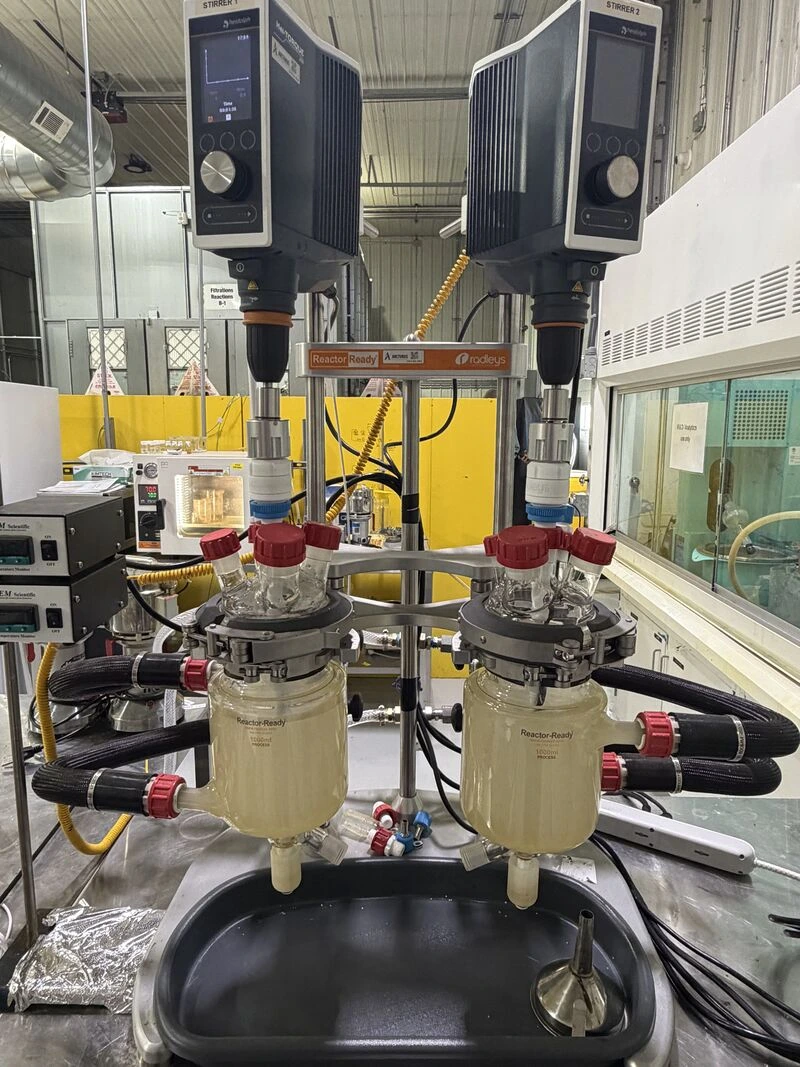

In laboratory chemistry, few settings feel as reassuring as a small, well-controlled reactor system. One-liter vessels, stable agitation, and efficient heat transfer create an environment where reactions behave predictably and data appears clean and repeatable. These conditions are essential for discovery and early process development, and they play a central role in building scientific confidence.
However, the same conditions that make bench-scale chemistry comfortable can also hide critical risks. When a process transitions from laboratory scale to pilot or production environments, challenges often emerge that were invisible earlier. These challenges are not a failure of chemistry itself, but a consequence of assumptions that were never tested under more demanding conditions.
Why Bench-Scale Experiments Feel So Reliable
Small-scale reactors are designed to eliminate variability. Mixing is typically vigorous enough to prevent concentration gradients, and heat transfer is highly efficient due to favorable surface-area-to-volume ratios. As a result, reaction kinetics appear smooth, side reactions are limited, and reproducibility is high.
This reliability is invaluable for understanding mechanisms and optimizing yields. Yet, it also creates an artificial sense of robustness. Many physical limitations—such as mass transfer resistance, thermal lag, or heterogeneous flow—are minimized or absent. Chemistry that performs flawlessly under these ideal conditions may actually depend on them.
How Unexamined Assumptions Take Root
Consistent success at small scale encourages implicit assumptions. Chemists may assume that mixing will always be sufficient, that heat can always be removed efficiently, or that minor impurities will not matter. These assumptions are rarely deliberate; they form naturally when nothing goes wrong.
The danger lies in the fact that these assumptions remain unchallenged. When systems grow larger, the safeguards of small-scale equipment disappear. Heat accumulates more easily, mixing becomes uneven, and reaction sensitivity increases. What seemed like a stable process can suddenly behave unpredictably.
What Scale Truly Tests
Scaling a chemical process does not inherently make chemistry less cooperative. Instead, it reveals the limits of prior understanding. Larger volumes amplify inefficiencies and expose dependencies that were previously hidden. Problems encountered during scale-up usually trace back to gaps in early testing rather than flaws in the reaction itself.
By treating scale as a diagnostic tool rather than a threat, chemists can reframe development challenges. The goal is to identify vulnerabilities early, while adjustments are still inexpensive and safe.
Conclusion
Bench-scale chemistry is where confidence begins, but it should not be where critical evaluation ends. Scale does not punish chemistry; it exposes what was never stressed when conditions were forgiving. By intentionally testing reactions beyond their comfort zone at small scale, scientists can design processes that remain reliable as complexity increases. True robustness is built not on ideal conditions, but on understanding how chemistry behaves when those conditions change.