
Cellular Resilience: Assessing the Impact of High-Purity vs. Crude Cannabinoids on Lung and Liver Health
As the global cannabinoid market shifts from traditional hemp extracts to highly potent synthetic and semi-synthetic analogs, the scientific community is intensifying its focus on the underlying safety of these compounds. Recent investigations into “emerging” cannabinoids like HHC (hexahydrocannabinol) and THCP (tetrahydrocannabiphorol) have revealed a complex landscape where molecular potency does not always correlate directly with biological safety. A critical area of concern involves how these substances, particularly in their “crude” or unrefined forms, interact with the primary metabolic and respiratory gateways of the human body: the liver and the lungs. A recent comprehensive safety assessment has highlighted the necessity for both manufacturers and consumers to prioritize high-purity, distilled products to mitigate the risk of cellular toxicity and adverse physiological events.
Evaluating Respiratory Cytotoxicity: High-Purity vs. Crude Formulations
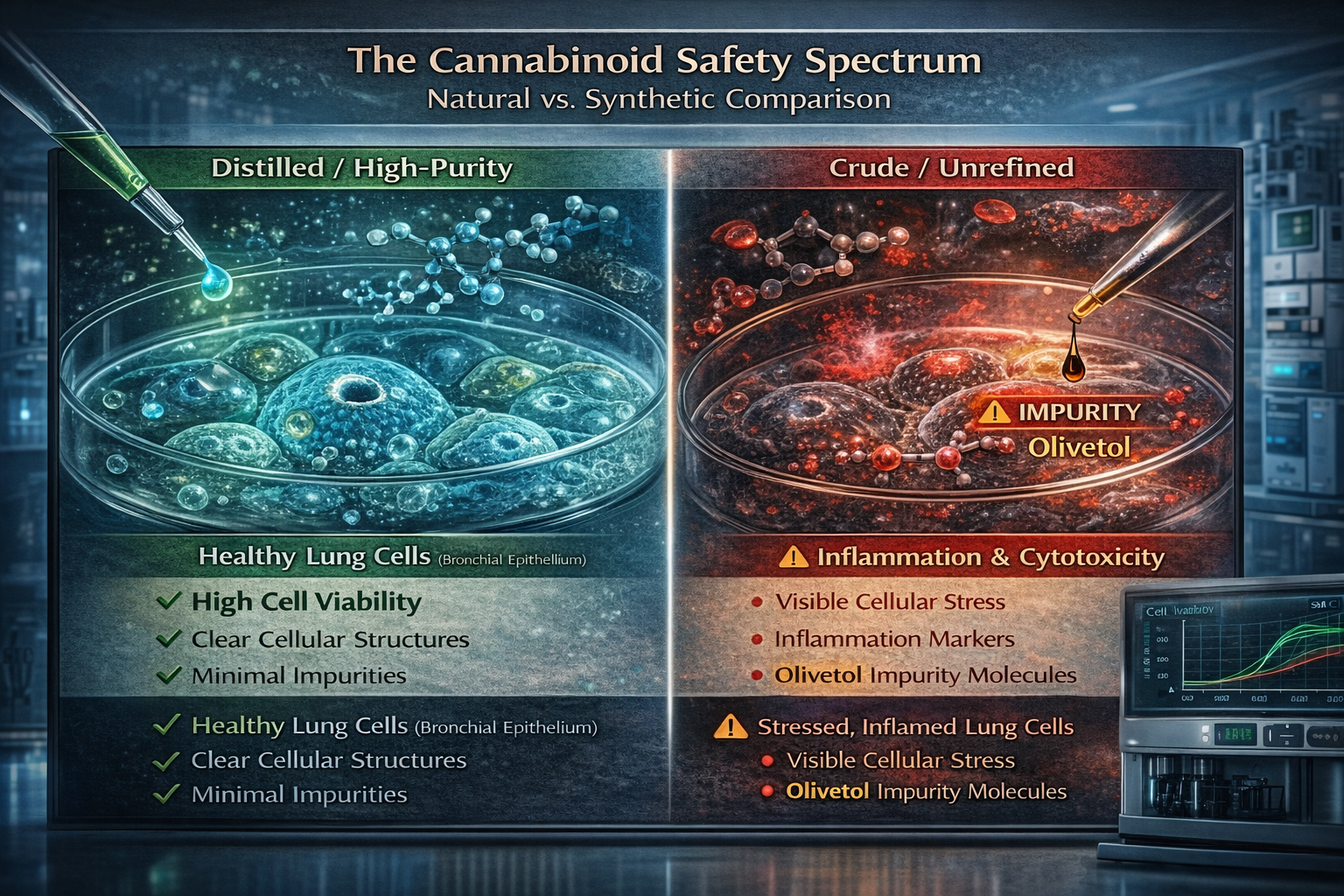
The inhalation of cannabinoid aerosols presents a unique toxicological challenge, as the lung epithelium is directly exposed to both active compounds and potential manufacturing byproducts. Comparative studies utilizing in-vitro lung cell lines—such as BEAS-2B bronchial epithelial cells—have demonstrated that the refinement level of a product significantly influences its cytotoxic profile. While high-purity cannabinoids like THC and HHC exhibit dose-dependent effects on cell viability, crude or poorly distilled extracts often contain additional reactive contaminants.
One of the most concerning findings in unrefined Delta-8-THC products is the presence of olivetol, a precursor that can act as a potent respiratory and skin irritant. In contrast, research into refined HHC has shown no significant cytotoxicity in lung fibroblasts at standard consumption levels, only exhibiting potential effects when concentrations exceed 10 mM. For consumers, this emphasizes that the “cleanliness” of a product is as important as its potency. High-purity, distilled cannabinoids are essential for ensuring that the therapeutic benefits of inhalation are not undermined by the inflammatory or oxidative stress induced by manufacturing residues.
Metabolic Architecture: Liver Safety and Cannabinoid Potency
The liver serves as the primary hub for cannabinoid metabolism, primarily through the Cytochrome P450 (CYP450) enzymatic system. When compounds like THC and HHC enter systemic circulation, they are subjected to first-pass metabolism, which can either deactivate the compound or transform it into more potent metabolites. The biological impact on hepatocytes (liver cells) is a key metric in modern safety assessments. Preliminary data on refined HHC, for instance, has demonstrated no significant cytotoxicity in human liver hepatocyte assays, suggesting a favorable metabolic safety profile when the compound is free of contaminants.
However, the “alphabet soup” of unregulated cannabinoids, such as THCP, introduces new variables. THCP features a seven-carbon side chain—longer than the traditional five-carbon chain of THC—which dramatically increases its binding affinity for CB1 receptors. While some hypothesize that higher potency could allow for lower doses and fewer side effects, others caution that the long-term metabolic impact on liver function remains under-researched. Ensuring that these potent analogs are produced in GMP-grade facilities is critical to preventing the liver toxicity often associated with the high-dose consumption of unregulated or low-quality cannabinoid products.
Implications for Public Health and Market Accountability
The current lack of federal oversight in the cannabinoid market has led to a reliance on “trust-based” transactions rather than standardized scientific verification. The presence of synthetic “Spice-like” contaminants or heavy metals in unregulated CPGs (Consumer Packaged Goods) highlights a looming public health risk. Research findings consistently emphasize that companies prioritizing clean, distilled products are not only protecting their consumers but also securing their competitive position in an increasingly scrutiny-heavy market.
For the industry to mature, the focus must shift toward rigorous, evidence-based safety standards. This includes the adoption of High-Performance Liquid Chromatography (HPLC) for comprehensive characterization and the implementation of in-vitro safety profiling for all novel analogs. By moving away from crude manufacturing and embracing high-fidelity refinement processes, the industry can avoid the pitfalls of past vaping-related epidemics and establish a scientific foundation for safe, effective cannabinoid therapeutics.
Conclusion
The safety of modern cannabinoids is a multi-faceted inquiry that transcends simple potency measurements. The biological response of lung and liver cells to these compounds is heavily influenced by the purity and refinement of the final product. As we continue to explore the potential of analogs like HHC and THCP, the data suggests that distilled, high-purity formulations are the only viable path forward for a safe and sustainable industry. Prioritizing clean products through rigorous analytical testing and GMP-compliant manufacturing is no longer a luxury; it is a critical necessity for consumer protection and the long-term viability of the global cannabinoid market.