




Navigating the Frontier of Cannabinoid Safety and Cardiac Risk
The rapid expansion of the cannabinoid industry has led to a surge in novel, semi-synthetic, and synthetic analogs. While the market often focuses on potency and shelf appeal, a critical gap remains in the physiological safety profiles of these new compounds. In professional pharmaceutical development, a compound’s journey often begins not with how well it works, but with how safely it interacts with the human heart. Central to this assessment is the hERG test, a non-negotiable preclinical hurdle that many emerging cannabinoids fail to clear. As these molecules move from niche research into broader consumer access, understanding the molecular implications of hERG inhibition is vital for manufacturers, researchers, and regulatory bodies alike.
The Biological Mechanism of the hERG Potassium Channel
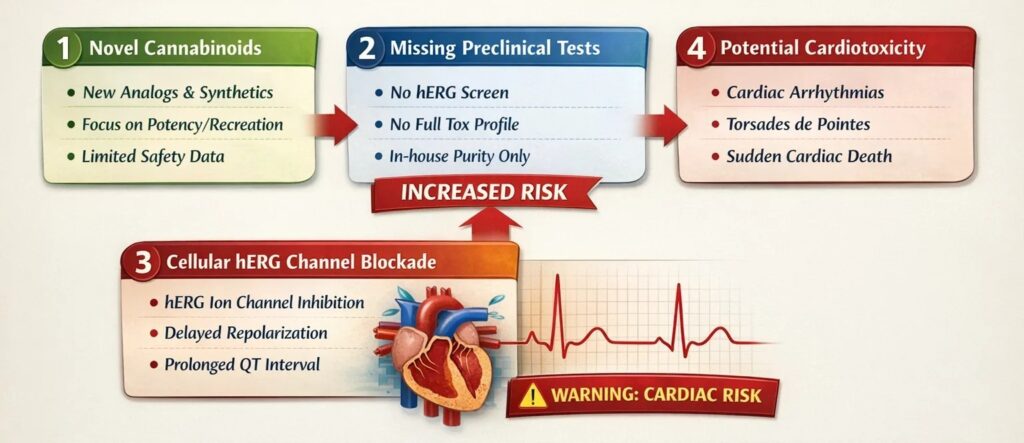
The human ether-a-go-go-related gene (hERG) codes for a protein that forms a specific type of potassium ion channel. This channel is primarily located in the cardiac myocytes—the cells responsible for the heart’s contraction. Its main role is to facilitate the repolarization phase of the cardiac action potential. Essentially, as the heart beats, potassium ions must flow out of these cells through the hERG channel to reset the electrical state of the heart, allowing it to beat again. If a foreign molecule, such as a novel cannabinoid, physically blocks or binds to this channel, the flow of potassium is restricted. This molecular logjam delays the electrical reset of the heart, a phenomenon known in clinical settings as QT interval prolongation.
Cardiac Arrhythmia and the Risks of Blockage
When the hERG channel is inhibited, the consequences are not merely theoretical; they are potentially fatal. A prolonged QT interval can trigger a specific and dangerous type of ventricular tachycardia called Torsades de Pointes. This condition disrupts the heart’s rhythm, preventing it from pumping blood effectively, which can lead to fainting, seizures, or sudden cardiac death. In the history of pharmaceutical development, several high-profile drugs have been pulled from the market post-release precisely because they were discovered to be hERG blockers. Because many novel cannabinoids are structurally diverse and highly lipophilic, they possess a high affinity for the deep, hydrophobic pocket of the hERG channel. Computational modeling of these analogs often reveals a startling trend: a significant percentage of these molecules show a high probability of cardiac toxicity.
The Regulatory Imperative and Preclinical Responsibility
In the eyes of agencies like the FDA or EMA, hERG testing is a cornerstone of the Integrated Risk Assessment for any new chemical entity. It is part of the Safety Pharmacology Core Battery required before a drug can even enter human clinical trials. For the cannabinoid industry to mature into a true pharmaceutical-grade sector, manufacturers must move beyond simple potency certificates. Relying on in-house testing that only covers purity is insufficient when dealing with novel scaffolds that have no historical safety data. Proactive hERG screening, whether through in silico computational experiments or in vitro patch-clamp assays, provides the unbiased data necessary to prove a compound is fit for human consumption.
Conclusion
The pursuit of innovation in cannabinoid science must be balanced by a commitment to rigorous safety standards. The hERG test represents a critical line of defense against cardiotoxicity, ensuring that the novelty of a compound does not come at the cost of public health. As research continues to uncover the therapeutic potential of cannabinoid analogs, the integration of hERG assessments into the standard development workflow will be the defining factor that separates credible laboratory science from high-risk manufacturing.