

The transition from a laboratory bench to a commercial production floor is often romanticized as a mere expansion of volume. However, seasoned industry experts understand that industrial chemical scale up is rarely a linear progression of success. While laboratory research focuses primarily on the elegance of molecular synthesis, industrial reality is governed by the unforgiving laws of fluid dynamics and mechanical resistance. When a process fails at scale, it seldom happens with the dramatic spectacle of a thermal runaway or a reactor breach. Instead, it fails quietly and incrementally, through a series of unplanned mechanical hurdles that slowly compromise the economic viability of the entire campaign.
From Molecular Kinetics to Mechanical Friction
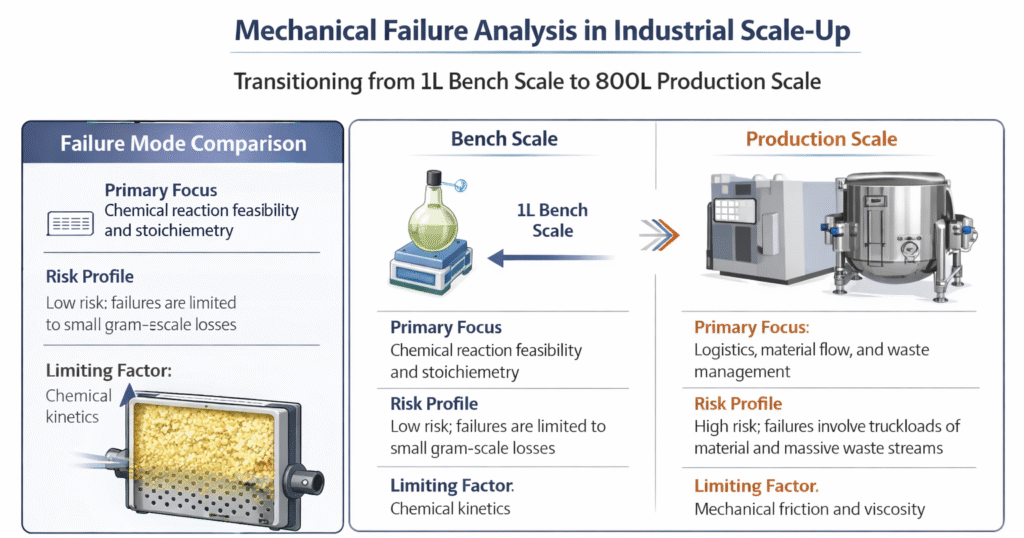
In a 1 liter environment, the chemist’s primary adversary is the reaction itself. Achieving the correct stoichiometry, managing heat of reaction in a small jacketed flask, and ensuring purity are the standard hurdles. At this scale, the physical properties of the mixture, such as viscosity and surface tension, are often negligible or easily managed by standard stirring.
Once the process reaches 800 liters, the fundamental problem shifts from chemistry to friction. The energy required to move high viscosity fluids through industrial piping, the pressure drops across massive filter beds, and the sheer resistance of bulk material create a landscape of mechanical stress. A reaction that was perfectly fluid in a small glass vessel can become an unmanageable sludge when subjected to the pumping and transfer requirements of a large scale facility. This friction does not stop the chemistry, but it introduces a “quiet” failure mode where the process becomes physically stagnant.
The Operational Attrition of Unplanned Byproducts
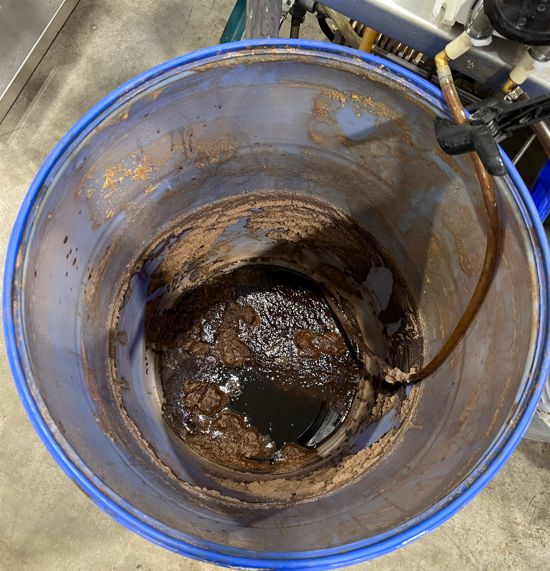
A successful industrial chemical scale up can be derailed by the sudden emergence of “secondary” materials that were invisible at the bench scale. In a laboratory, a few milliliters of a thick, amorphous byproduct might be dismissed as a minor impurity. In an 800 liter run, that same byproduct translates into a 200 liter drum of unplanned sludge.
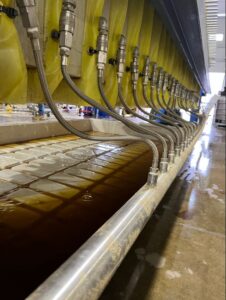
These materials frequently lead to “filter blinding,” a critical operational failure where the filter media becomes entirely obstructed halfway through a batch. When this happens, the process does not explode; it simply stops. The time lost to clearing a blinded filter, the solvent used for cleaning, and the labor required for manual intervention do not necessarily destroy the chemical yield of the product. Instead, they erode the operational margin. By the time the production team notices the bottleneck, the project is no longer a high-value synthetic success, but a logistical burden that is consuming its own profitability.
Mechanical Hardware and the Limits of Viscosity
Industrial hardware is designed with specific operational windows, yet scaling often pushes these machines to their absolute limits. Pumps that operate perfectly with water-like fluids can fail or cavitate when asked to move a viscous reaction intermediate. Transport lines can slowly “choke” as solids precipitate in cool spots or as the sheer force of the fluid creates internal wear on seals and valves.
This erosion of hardware integrity is a silent failure that accumulates over time. It manifests as a slow cycle time or a gradual increase in energy consumption per batch. In the world of commercial manufacturing, these inefficiencies are cumulative. If a pump is struggling or a line is restricted, the facility is paying for every minute of delay. A “survivable” process at scale is one where the mechanical limits were engineered with the same precision as the chemical reagents.
Conclusion
Industrial scaling is a transition from the world of molecules to the world of mass. While chemical kinetics define the feasibility of a project, mechanical physics and logistics define its commercial survival. Recognizing that industrial chemical scale up fails through erosion rather than explosion is the first step toward building a resilient manufacturing process. Success is found in the ability to anticipate the sludge, engineer for the friction, and protect the margin from the quiet failures of scale.